Trend signal direction
Emerging social moments, formats, topics, and platform signals become the starting point for stronger content planning.
A pre-launch trend-to-content platform helping creators, brands, social media managers, and agencies turn fast-moving social signals into sharper content angles, hooks, scripts, and campaign direction.
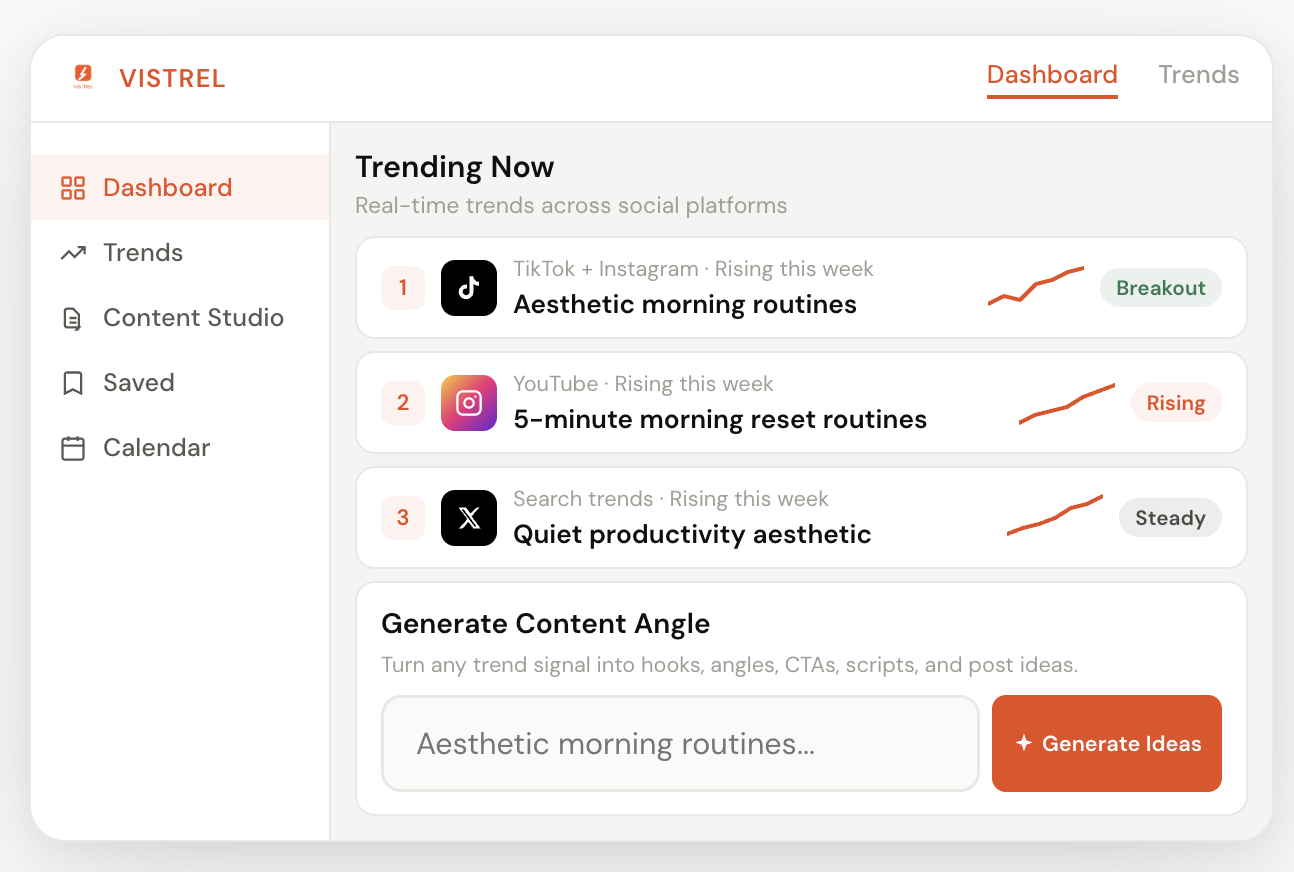
Vistrel is being shaped around a simple gap in the content workflow: trends move quickly, but turning them into usable angles, hooks, scripts, and posting ideas still takes too long.
The current stage is not a full launch. It is a focused waitlist and early-access phase designed to test the clearest promise before building out the wider platform experience.
Most trend tools stop at discovery. They show what is moving, but they do not help a creator, brand, or agency decide how to use the signal in a way that fits the audience, offer, format, and campaign goal.
Vistrel is positioned around the missing middle: not just spotting trends, and not just generating generic posts — but turning signals into sharper, usable content direction.
The waitlist experience needed to make Vistrel feel bigger than a trend list, but more focused than a generic AI writing tool. The promise is speed with strategy.
Emerging social moments, formats, topics, and platform signals become the starting point for stronger content planning.
Trend signals are reshaped into audience-specific ideas instead of being left as raw inspiration.
The product direction focuses on practical outputs creators and teams can actually turn into posts, briefs, and campaigns.
Vistrel is designed to help ideas stay useful to the brand, not just reactive to the trend.
The challenge was to position Vistrel as a strategy layer between trend discovery and content execution, without overclaiming before the product is fully launched.
For Vistrel, the core product loop is the case study: spot the signal, shape the angle, generate direction, and decide what to post.
Identify the trends, formats, topics, and platform signals that are gaining attention.
Turn the trend into audience-specific ideas that fit the brand, offer, or campaign goal.
Create hooks, scripts, CTAs, content angles, and posting concepts from the trend signal.
Save stronger ideas and move from scattered inspiration to usable content direction.
The product direction deliberately avoids becoming a broad social media tool. The strongest wedge is the moment between spotting a trend and knowing how to use it.
Vistrel is positioned as the middle layer between trend research and content execution. The aim is to help users move from “this is trending” to “this is the angle we can actually use.”
The case study positions Vistrel as a waitlist and validation-stage product, not a fully launched platform.
The messaging speaks to creators, brands, social media managers, and agencies that already feel trend pressure.
The product promise prioritises better direction, not endless content generation for its own sake.
The current experience tests the offer, audience language, and product promise before a deeper buildout.
Because Vistrel is still pre-launch, the case study uses fewer visuals. The goal is to show product direction, positioning, and early-access intent while the full platform experience is still being shaped.
A visual preview of the intended product experience: trend signals on one side, content angle generation on the other.
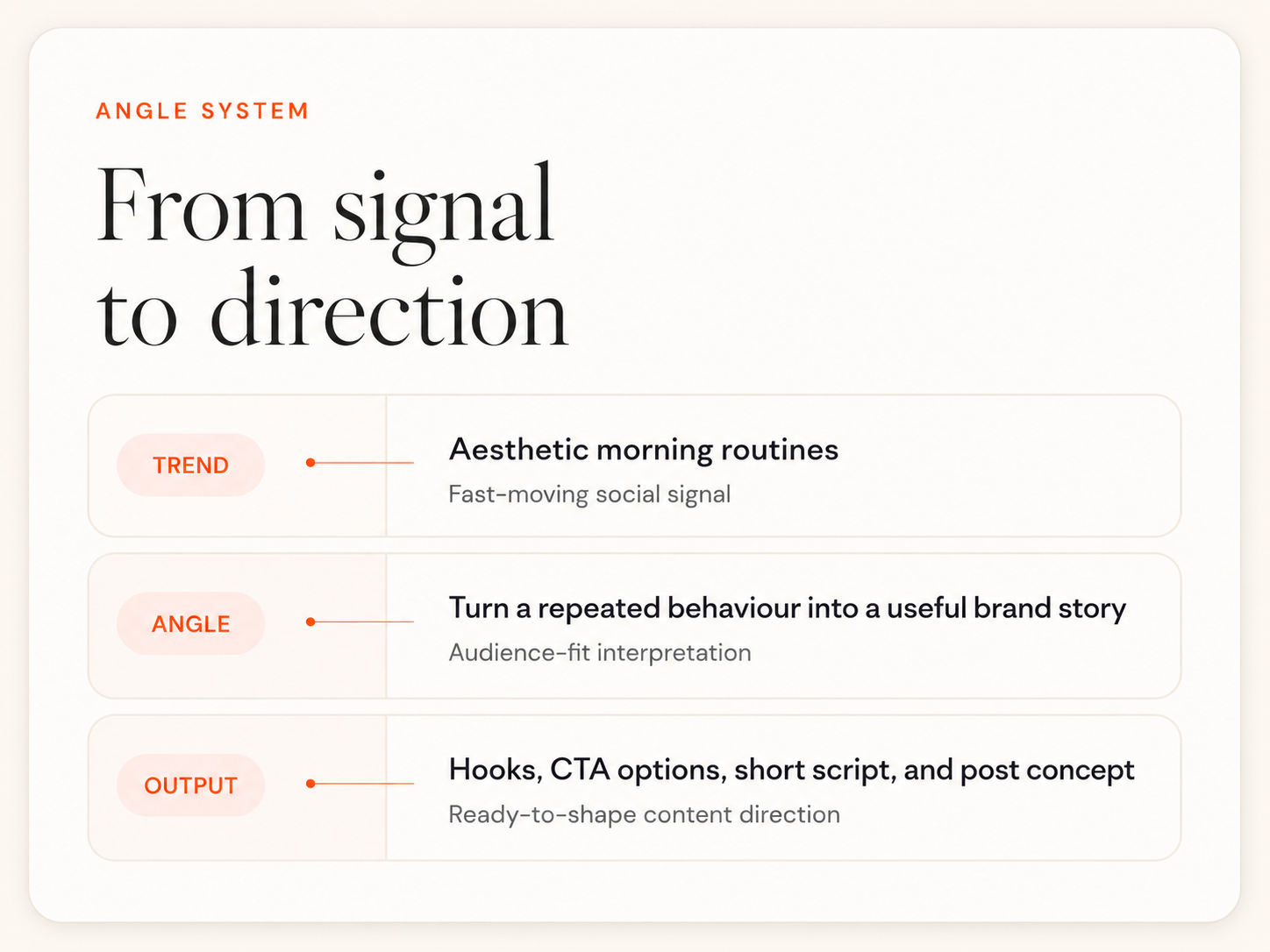
The product concept is built around interpretation: helping users turn a social signal into a usable creative direction.
The current goal is to test whether the promise is clear enough to attract creators, brands, social media managers, and agencies before committing to a full platform build. The waitlist is part of the product strategy, not just a placeholder page.
Vistrel reinforced that pre-launch product work can still be strategic, polished, and commercially useful when the promise is specific enough to test.
The value is not only in spotting what is moving. It is in translating the signal into an angle people can use.
Fast content is only useful when the workflow still helps users choose direction, tone, and format.
The waitlist page is part of the product system: it tests language, demand, audience fit, and the commercial promise before the deeper buildout.